
External Resources
Local Government Policy
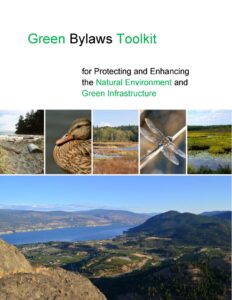
Green Bylaws Toolkit for Protecting and Enhancing the Natural Environment and Green Infrastructure
The Green Bylaws Toolkit shares information in relation to the planning tools available to local governments for the protection and stewardship of the natural environment. The toolkit provides applied examples for each of the tools and discusses the opportunities and challenges with applying them. Section 3 of the toolkit provides sample bylaw provisions with examples of language that planners could use.
Available at https://stewardshipcentrebc.ca/green-bylaws/
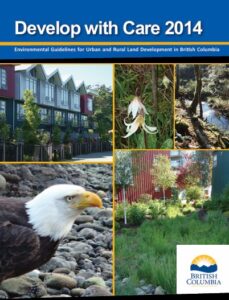
Develop with Care: Environmental Guidelines for Urban and Rural Development in British Columbia
The Develop with Care is a series of guidelines that the province produced in 2014 to maintain
environmental values during the development of urban and rural lands. The guidelines include the following sections:
- Community Planning
- Site Development and Management
- Environmentally Valuable Resources
- Regional Information
These guidelines can be accessed here.
Natural Solutions Initiative: Regulatory Mechanisms Toolkit. Action on Climate Team, Simon Fraser University
Municipalities are seeking ways to incorporate the protection of nature-based solutions to climate change into their planning and decision making. However, planners have indicated that they struggle to identify appropriate regulatory mechanisms for achieving that goal. This toolkit has been designed to support that process and to be applied at two scales – watershed and community.
This toolkit can be accessed here.
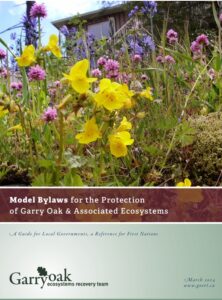
Model Bylaws for the Protection of Garry Oak and Associated Ecosystems
The purpose of the Model Bylaws for the Protection of Garry Oak is to support local governments and First Nations in the development of regulations to protect Garry oak and its associated ecosystems which are some of the most imperiled ecosystems on Earth.
Governments often have to find a balance between environmental protection with economic, cultural and social outcomes, but south west BC has some of the rarest ecosystems due to colonization, urban development, agriculture and forestry.
To access this guidance document click here.
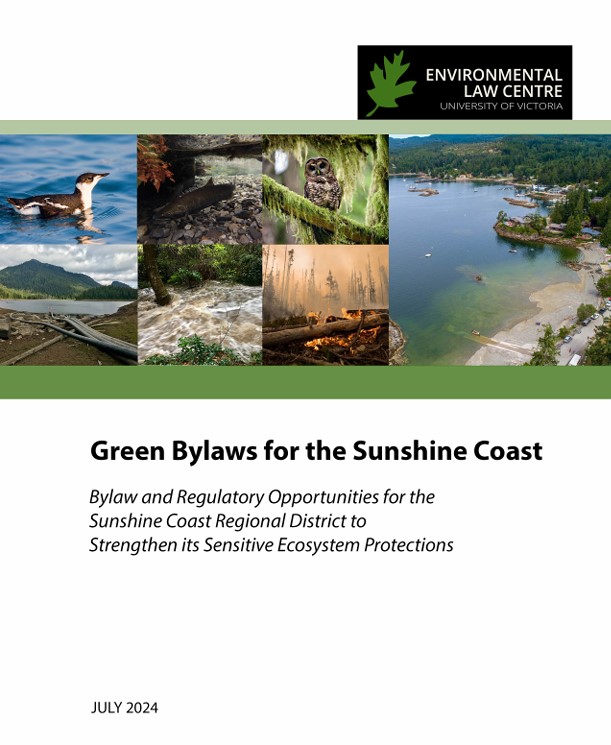
Green Bylaws for the Sunshine Coast: Bylaw and Regulatory Opportunities for the Sunshine Coast Regional District to Strengthen its Sensitive Ecosystem Protections
The purpose of this report was to review the Sunshine Coast Regional Districts existing approach to the protection of ecosystems and to make recommendations as to how these could be strengthened. The recommendations put forward include:
- Support ecosystem connectivity
- Establish long-term, district-wide objectives and policies
- Establish binding mechanisms to guide development away from sensitive ecosystems
- Enhance the power and efficiency of environmental impact assessment procedures
- Ensure that planning and development decisions are based on a comprehensive and
scientific base of knowledge
To access this report click here.
| British Columbia Climate Action Charter between the Province of British Columbia and the Union of British Columbia Municipalities and Signatory Local Governments. https://www2.gov.bc.ca/assets/gov/british-columbians-our-governments/local-governments/planning-land-use/bc_climate_action_charter.pdf |
| District of Saanich website, “Biodiversity Conservation Strategy”. https://www.saanich.ca/EN/main/ community/natural-environment/resilient-saanich-environmental-policy-framework/biodiversity-conservation-strategy.html |
| Metro Vancouver Connecting The Dots: Regional Green Infrastructure Network Resource Guide. https://metrovancouver.org/services/regional-planning/Documents/connecting-the-dots.pdf |
| Makaroff, D. & Morse, D., 2024, How to Finance the Restoration of Old Growth Forests through OCP Policies, Residential Density Transfer and Community Land Stewardship Zoning, Plan Canada, Fall 2024 issue, Canadian Institute of Planners. https://www.cip-icu.ca/learning-hub/plan-canada-issue-progressive-planning-policies-and-tools/ |
First Nations policy
| First Nations Carbon: A BCAFN Discussion Paper, 2022, Prepared for BC Assembly of First Nations. https://www.bcafn.ca/sites/default/files/docs/reports-presentations/BCAFN-Carbon%20Offset%20Discussion%20Paper_Feb%202022_%20Web_0.pdf |
| First Nations Carbon Toolkit BC Assembly of First Nations and Ecotrust. https://www.carbontoolkit.org/about |
| Cheakamus Community Forest Carbon Offsets briefing note, 2020, Ecotrust Canada. https://ecotrust.ca/wp-content/uploads/2020/03/Briefing_CheakamusCarbon.pdf |
| Land Codes, Lands Advisory Board website. https://labrc.com/resource/land-codes/ |
We Rise Together: Achieving Pathway to Canada Target 1 through the creation of Indigenous Protected and Conserved Areas in the spirit and practice of reconciliation, 2018, Indigenous Circle of Experts (ICE). https://publications.gc.ca/site/eng/9.852966/publication.html |
| Collaborative Stewardship Framework, BC Government Natural Resource Stewardship website. https://www2.gov.bc.ca/gov/content/environment/natural-resource-stewardship/consulting-with-first-nations/collaborative-stewardship-bc/collaborative-stewardship-framework |
| Land Trusts and Indigenous Peoples: the Canadian Context, 2024, Gansworth, K.L. Prepared for the Conservation through Reconciliation Partnership. 26 pp. https://ipcaknowledgebasket.ca/wp-content/uploads/2024/05/Land-Trusts-and-Indigenous-Peoples-FINAL-May-2024.pdf |
| Key Biodiversity Areas (KBA) Project, Centre for Indigenous Environmental Resources website. https://yourcier.org/key-biodiversity-areas-project/ |
| Tla’amin Forest Resource Plan (created using some of the pilot layers for the biodiversity atlas). https://www.tlaaminnation.com/forest-resource-plan/ |
Land Stewardship
Climate Change Adaptation
Pacific Institute for Climate Studies data analysis tools. https://www.uvic.ca/pcic/data-analysis-tools/analysis-tools/index.php |
AdaptWest Climate Adaptation Data Portal. https://adaptwest.databasin.org |
Metro Vancouver Climate Strategy for 2050. https://metrovancouver.org/services/air-quality-climate-action/climate-2050 |
“Nature-based solutions”, Raincoast website. https://www.raincoast.org/reports/nature-based-solutions/ |
“Natural Climate Solutions”, Nature United website. https://www.natureunited.ca/what-we-do/our-priorities/innovating-for-climate-change/natural-climate-solutions/ |
Fire risk reduction in the Coastal Douglas-fir biogeoclimatic zone, Raincoast, https://www.raincoast.org/2023/09/fire-risk-reduction-coastal-douglas-fir-zone/ |