
About Action for Adaptation
Collaboration for Climate Solutions
In 2022, the UBC Botanical Garden and the Coastal Douglas-fir Conservation Partnership (CDFCP) came together to develop a biodiversity atlas and climate adaptation tools. Our project aims to support First Nations, local governments, land managers and conservation organizations in making informed decisions about biodiversity in a changing climate. This website was created to address gaps in mapping and policy tools that planners identified through conversations with us.
Territorial Land Acknowledgement
The Action for Adaptation project is based on the unceded territories of 63 First Nations. We acknowledge that Indigenous Peoples have stewarded the land, water, and air of the southwest coast of British Columbia for millennia.
The project focuses on listening to the priorities of Indigenous land-use planners and responding, where appropriate, to the gaps they identify. We are continually learning how to present mapping information in ways that are meaningful and useful.
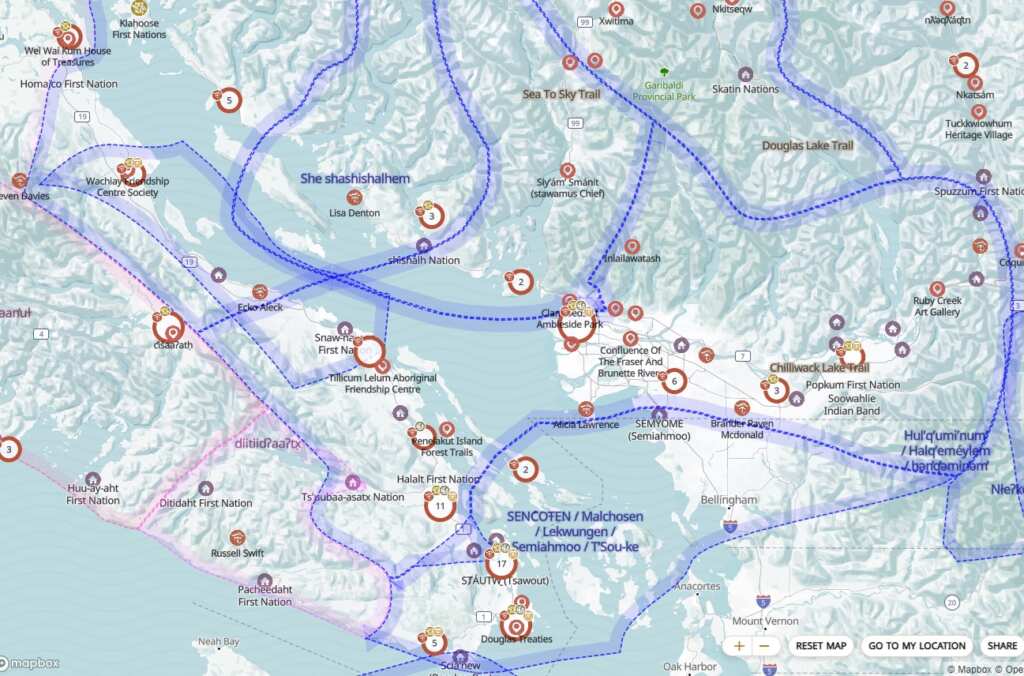
Map of Project Area
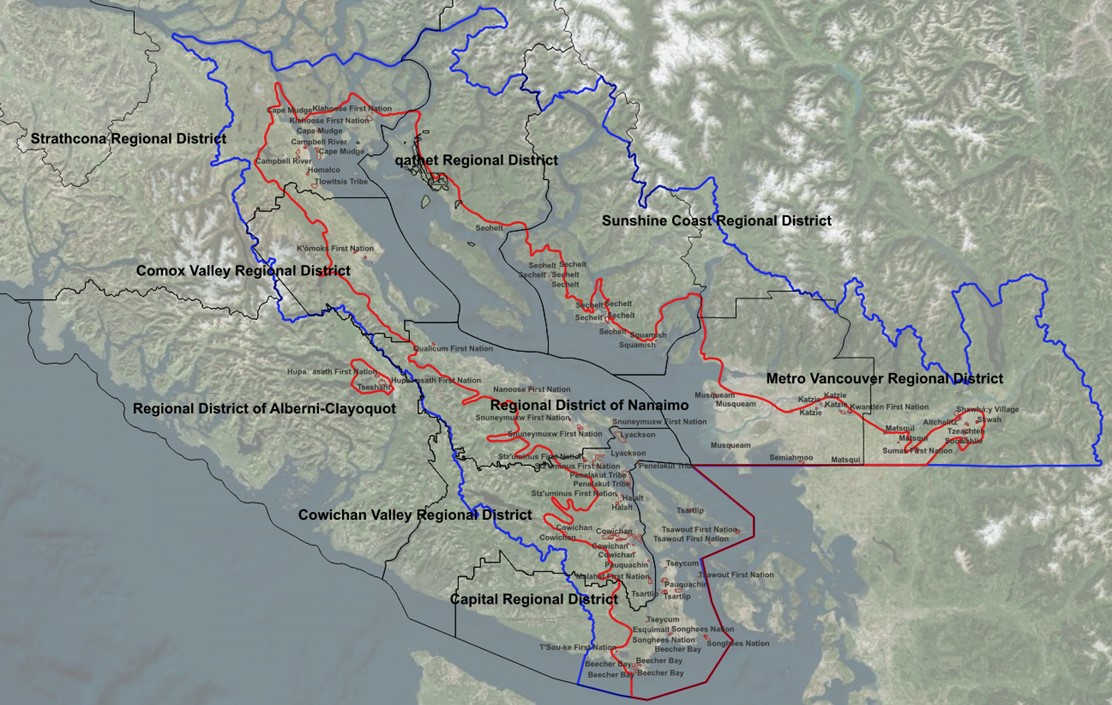
Our project area encompasses south-eastern Vancouver Island, islands in the Salish Sea, the Lower Mainland and parts of the Fraser Valley.
The rationale is to focus on the conservation of ecosystems associated with the Coastal Douglas-fir moist maritime biogeoclimatic subzone (CDFmm), which is the smallest and most at-risk zone in BC and is of conservation concern. The project area also includes other adjacent ecosystem types such as the Coastal Western Hemlock, Eastern Very Dry Maritime (CWHxm1) subzones.
The Red boundary depicts the CDFCP focus area – which is the Salish Sea’s dry lowlands comprising Coastal Douglas Fir and associated ecosystems.
The Blue boundary shows the Action for Adaptation study area – which includes the watersheds that flow into the CDFmm and the CWHxm1.
Why the ecosystems of southwest BC important
The lowlands of southwest British Columbia’s (BC) host 61% of BC’s population.
The area includes the Coastal Douglas-fir subzone (CDFmm), home to a large number of species and ecosystems at risk in BC.
These ecosystems provide critical services, including supplying water, urban cooling flood control, removal of particulates from the air and carbon storage and sequestration.
As the traditional territory of the Coast Salish and other First Nations, these ecosystems are important as they provide indigenous food security, and support culturally important plants and animals.
Increasing demand for residential development and timber are intensifying pressure on the area’s natural assets and the ecosystem services they provide. These pressures are compounded by climate change threatening the well being of BC’s south coast communities, and their capacity for adapting to climate change.
Climate change, as well as human development, has led to an increased risk of wildfire, drought, sea level rise, floods, landslides, storms and extreme weather events like the heat dome, that impact human health and well-being.
There is a need to keep the last remaining sensitive ecosystems in this area resilient.
Our Team
The Action for Adaptation project was conceived by Kelly Chapman and developed by staff at the Coastal Douglas Fir Conservation Partnership and the UBC Botanical Garden, as well as several mappers and researchers.
Stay Connected
Sign up for updates on our progress, new resources, and opportunities to get involved in building a climate-resilient BC.