First Nations
Carbon Offsetting
Carbon offset projects offer opportunities to earn carbon credits by carrying out activities that help offset atmospheric emissions that make climate change worse. These credits can then be sold in a carbon market as a source of revenue. In BC, land-based carbon credit projects are primarily in forests.
Ecotrust Canada and the British Columbia Assembly of First Nations (BCAFN) have partnered to create an online First Nations Carbon Toolkit, focused on First Nations’-led forest carbon projects in British Columbia.
British Columbia Assembly of First Nations (BCAFN) video on how climate change is impacting on First nations. This video is included in the Tool Box mentioned below.
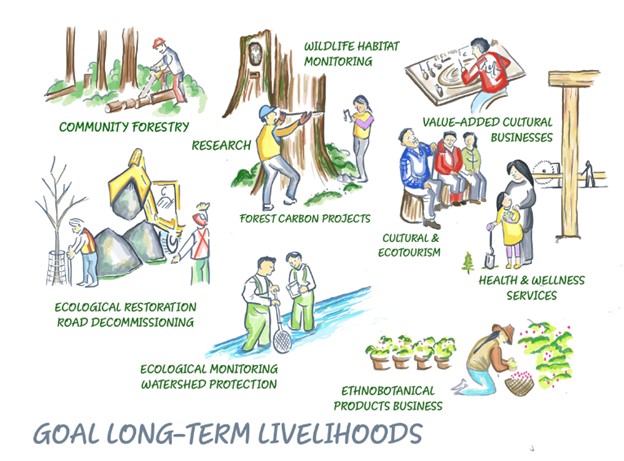
First Nations Carbon Toolkit image illustrating the potential opportunities to First Nations when establishing a carbon project.
Description
British Columbia has the ambitious objective of reducing its greenhouse gas emissions by 33% and 80% from the 2007 level by 2020 and 2050, respectively. Carbon offsetting is a tool that could help the province achieve this target.
A carbon offset is an independently verified credit for net greenhouse gas reductions achieved by one party that can be used to compensate (or offset) the emissions of another party. Carbon offsets are typically measured in tonnes of carbon dioxide-equivalents (or tCO2e), transacted through carbon registries, and bought and sold for voluntary or regulated emissions reductions.
Carbon offset projects offer opportunities to earn carbon credits by carrying out activities that help offset atmospheric emissions that make climate change worse. These credits can then be sold in a carbon market as a source of revenue. In BC, land-based carbon credit projects are primarily in forests.
The concept of carbon markets emerged from international climate change talks in the late 1990s. Carbon markets are trading systems in which carbon credits are sold and bought. The carbon market connects the supply and demand of emissions reductions and removals, resulting in the sale and purchase of carbon credits.
There are two broad types of carbon markets:
- Compliance markets are regulated by regional, national or international regimes of emission reductions. In compliance markets, offset credits are purchased by emitters that must comply with mandatory, legally-binding emissions reductions targets that are supported by legislation.
- Voluntary markets exist outside of government-mandated compliance programs. Voluntary markets enable entities such as businesses, governments, and nongovernmental organizations to voluntarily purchase carbon credits. Compliance markets are currently limited to specific regions, but voluntary carbon credits are not constrained by boundaries set by colonial governments, nation states or political unions. Project proponents are in the best situation when there are both voluntary and compliance markets in their jurisdiction, because this diversifies and can increase demand for credits.
Key Considerations
High-quality forest carbon projects that are led by First Nations can be a path towards community land management and sustainable revenue.
Land-based carbon offsets can generate revenue from the protection of the physical properties of the land, they can be a tool to enable the re-establishment of First Nations land stewardship and return social and ecological balance to communities while aligning with ecosystem-based management practices and First Nations’ rights and responsibilities.
The role of BCAFN
The BC Assembly of First Nations (BCAFN) received a mandate from First Nations leadership to support community-led climate initiatives across the province. The BCAFN responded by preparing a Discussion Paper and Toolkit to provide guidance for communities interested in understanding carbon project opportunities. These resources can help First Nations understand the regulatory framework and protocols that underpin forest carbon projects in BC.
Canada's National Carbon Monitoring Program
The World Wildlife Fund (WWF) Canada and its partners are developing a Community of Practice and a data platform as part of WWF-Canada’s National Carbon Monitoring Program, which aims to connect communities with science and technical capacity to measure, map and monitor ecosystem carbon to evaluate and implement nature based climate solutions (NbCS) that maximize benefits.
Group / Aggregate Carbon Project
If a First Nations is constrained by a small land base they may wish to explore project aggregation (grouping), which can mean two things: either when a single First Nation bundles smaller parcels of land into a project of a larger size in order to increase the economic feasibility of a project; or, where multiple First Nations bring multiple projects together to share project costs and register a project as a group. The Great Bear Forest Carbon Project is an example of an aggregated forest carbon offset project.
Rights and Title
The rights of First Nations in BC are land-based Aboriginal rights, and First Nations communities have the right to the carbon stored and absorbed across their lands and the potential revenues related to such carbon. However, all Crown land based forest carbon offset projects in BC must comply with the Greenhouse Gas Industrial Reporting and Control Act (GGIRCA) and the Greenhouse Gas Emission Control Regulation (GGECR).
If a carbon project is on Crown land, BC currently allocates the right to benefit from the sale of carbon credits through an Atmospheric Benefit Sharing Agreement (ABSA). The Minister of Forests and the Minister of Indigenous Relations and Reconciliation currently have the authority to approve ABSAs, which are typically re-negotiated every five years. The Province can and does often retain a share of the revenue obtained through the sale of carbon credit as a condition of approval. This places limitations on the revenue available to First Nations, and there have been disagreements between First Nation carbon project proponents and BC on what represents a fair and equitable economic benefit sharing. The fact that the Province has not yet ratified a policy on ABSAs places further obstacles in negotiation processes. Nonetheless, an ABSA can be a tool First Nations could use to influence activities that take place on Crown land in their territory.
Barriers
Establishing a carbon offset project can be a long, daunting, and complex process that drains financial and human resources. Also, the carbon sector is still evolving, with multiple changes and market variability; for a variety of reasons, there is still a surplus of credits on the market, so new proposals might not find buyers.
Story Maps
The following case studies showcase carbon offset projects where large parcels of Crown land are available. While this is not necessarily the case for First Nations on Vancouver Island or the Lower mainland, these case studies demonstrate that First Nations-led carbon offset projects can be realized and can yield positive outcomes.
Great Bear Initiative / Coastal First Nations Carbon Project
The Great Bear Rainforest (GBR) Carbon Project is an aggregate project that bundles several land parcels together, covering over 5 million ha of BC’s central coast, covering three areas (Haida Gwaii, North Mid Coast, and South Central Coast). It spans the unceded and overlapping territories of the 14 First Nations who developed it, and who collectively make up the Coastal First Nations (Wuikinuxv, Heiltsuk, Kitasoo Xai’xais, Nuxalk, Gitga’at, Gitxaala, Metlakatla, Old Massett, Skidegate, and Council of the Haida Nation). The project land encompasses temperate rainforest and coastal ecosystems.
History
The GBR Project arose in the wake of years of protests and legal conflicts between First Nations and the federal and provincial governments over rights to fish and forest harvesting. After high-profile anti-logging campaigns, landmark agreements in 2006 and 2009 set aside protected areas and set conservation targets that supported the development of a carbon offset project.
In 2009, Coastal First Nations launched the GBR Project with the provincial government, making it the first Indigenous-led carbon project in North America. It was validated under BC’s Forest Carbon Offset Protocol (FCOP V1.0) and has offset more than 1 million tonnes of CO2 annually since 2012.
The sale of carbon credits enable the Coastal First Nations to move away form industrial logging practices in the forest; protect important ecological and environmental values; and generate a source of revenue for economic self-sufficiency.
Projects and Benefits
The GBR project is divided into three sub-projects: the Great Bear South Central Project, the Great Bear North and Central Mid-Coast project, and the Great Bear Rainforest Haida Gwaii project. The projects use Improved Forest Management actions to generate offsets by reducing logging. Collectively they conserve 50-80% of standing growth that would have been logged under the previous annual allowable harvest set by the provincial government.
The provincial government has been the main purchaser of the GBR carbon credits, as well as some sales to voluntary markets. In 2021, BC purchased offsets from the three sub-projects to a total amount of $5.4 million. Revenue generated from the sale of offsets has allowed more priority forest areas to be protected, has contributed to greater development of a Guardian Program and has helped cover some community building costs. The GBR Project generates over 8 million tonnes of carbon credits annually.
Challenges
The project, which was developed specifically to fund protection and stewardship, has faced challenges. By 2020, it was struggling to find carbon credit buyers, putting the entire stewardship and protection framework at risk.
The provincial government buys about 600,000 to 700,000 tonnes of carbon offsets each year to account for what it generates in emissions. But the Great Bear Rainforest produces much more than the province needs. As of 2020, it held 1.9 million tonnes of unsold credits.[2] The voluntary market, however, is increasingly creating demand.
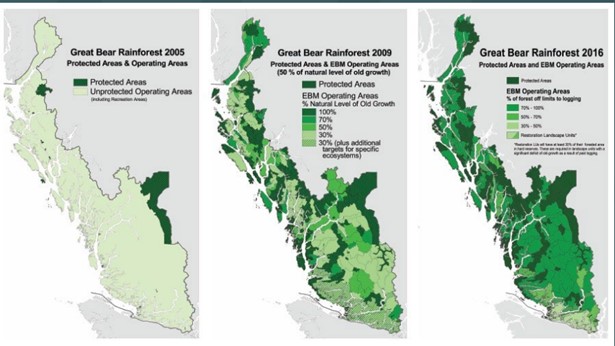
Great Bear Rainforest carbon offsets initiative protected areas and ecosystem-based management operating areas on the north and central mid-coast of BC.
Cheakamus Community Forest
The Cheakamus Community Forest (CCF) lies on the overlapping unceded territories of the Sḵwx̱wú7mesh Úxwumixw (Squamish Nation) and the Lil̓wat7úl (Líl̓wat Nation), surrounding the Resort Municipality of Whistler (RMOW). The CCF was created following an announcement from the Ministry of Forests that the timber harvest volume around Whistler would be available for a new tenure through the new Community Forest Program. The CCF is owned by the Squamish Nation, Lil’wat Nation, and the RMOW, as equal partners holding the common belief that the people of the region should manage forest harvesting according to their values.
Agreement
The Cheakamus Community Forest Society manage 33,000 ha of forest, and operate as an independent non-profit. The agreement became official in 2009 with the signing of a 25-year tenure with the then provincial Ministry of Forests and Range. The CCF was one of the first forest operations in BC to employ ecosystem based management, a holistic approach that reflects the land use plans of all three partners and considers all aspects of an ecosystem, including the human factor, and determines the best way to ensure its ongoing viability.
Reduced Timber Harvest
The CCF Society successfully negotiated with the Ministry of Forests to reduce the amount of timber harvested from 40,000 m³ to 21,000 m³ with about 15,000 ha being protected from commercial harvest through a variety of legal and voluntary mechanisms. This means animals and ecosystems can flourish and recreational opportunities can expand, while new forestry practices can be explored and refined. Actions are guided by the CCF’s ecosystem-based management plan, and delivered through reduced harvest volumes, extended harvest rotations, expanded reserves, and protection of old-growth forests and other important wildlife habitats.
Management Techniques
The types of management techniques used in the CCF result in carbon being stored on the land in the form of living and dead biomass that would have been released into the atmosphere under conventional forest management practices. Some of these techniques include:
- Setting areas aside for cultural and ecological values, including rare ecosystems, broader riparian reserves, and area of high traditional or spiritual use or value;
- Using small patch cuts, selective harvest, extended harvest rotation, and other harvest techniques that are designed to mimic natural disturbance;
- Undertaking stand thinning in second growth stands to accelerate return to old forest conditions; and
- Reducing fire risk for the forest and the community.
The resulting carbon sequestration offered an opportunity to negotiate an agreement with the Province to sell carbon offsets generated by its improved forest management approach.
Carbon Offsetting
The CCF carbon offsetting project reduces greenhouse gas emissions by approximately 10,000 tonnes of CO2 per year. During the first verification period from 2009 to 2013, the project generated 65,546 carbon credits.
The project has sold approximately 150,000 credits to many BC businesses including VanCity, Tinhorn Creek, Sharp Six Consulting, Ecotrust Canada, Brinkman Climate, Eclipse Awards, Local Practice Architecture, MET Fine Printers, Epic Investment Services, and the RMOW. These offset purchases contribute to each organization’s own climate goals of going carbon neutral.
While the revenue from offset sales does not currently cover the entirety of CCFs operational costs, the federal compliance market price of carbon emissions is predicted to continually increase from $65 per tonne of CO2e in 2023 to $170 by 2030, which may support higher price negotiation with the provincial government and bring enhanced economic security.
Rights and Title
Community Forest Agreements and Indigenous-led carbon projects such as the CCF can bring exclusive use rights and can be a productive tool in redistributing decision-making power away from Crown and private corporations and into the hands of local communities. Historically, Líl̓wat Nation did not see any of the benefits from harvesting that occurred in their own territory, and so took direct action to prevent big forestry companies from gaining access. Now they hold the majority of tenure to their lands, with annual harvesting projects divided equally between Lil’wat Forestry Ventures LP and Squamish Forestry LP.
The carbon credits generated by the CCF carbon credit project are quantified using the BC Forest Carbon Offset Protocol (FCOP V1.0), and verified to the BC Emissions Offset Regulation.
The Future of Forestry: Cheakamus Community Forest