First Nations
Collaborative Tables
A collaborative table is a way of describing the process where First Nations come together—often physically at a table—with representatives from other governments, organizations, and businesses that all have an interest in a place, with the goal of solving problems and resolving conflicts. Almost any of the approaches described in this toolkit could be considered a collaborative table, if the process involves more than one First Nation, group, or government.
Description
There is no one way to establish or manage a collaborative table, and there are as many forms as there are issues of concern to First Nations about lands and waters. The process is typically open and transparent, and might be based on a set of principles for how the participants will work together, often set out in an agreement with terms of reference that everyone signs.
A formalized version of collaborative table, the Collaborative Stewardship Framework (CSF) is an initiative of the Province of BC that intends to enable the province and Indigenous groups to explore, through regional collaborative stewardship forums, shared responsibility for environmental stewardship and options for making resource management decisions in BC in ways that reflect both Indigenous and Western knowledge. In 2018, the province initiated five CSF pilot projects involving more than 30 First Nations.[1]
Three case studies, one of which is a CSF pilot project, are presented below. They help illustrate that, although challenging and time-consuming, the collaborative table approach may be one of the best tools for First Nations to navigate BC’s complex land and water jurisdictional landscape.
Collaborative Stewardship Framework website, “Collaborative Stewardship Framework”
Story Maps
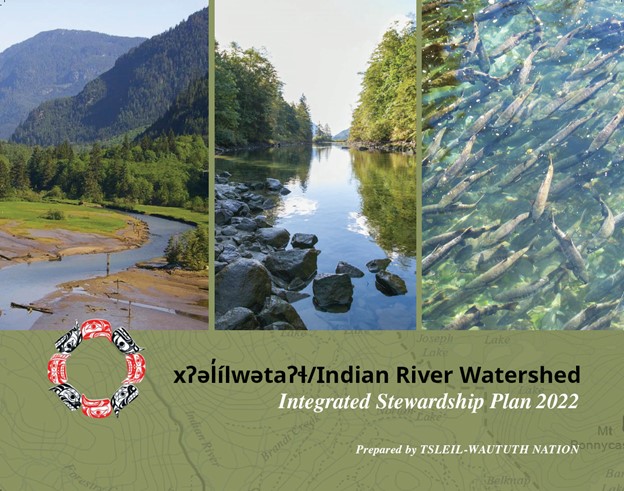
xʔəlilwətaʔɬ/Indian River Watershed Integrated Stewardship Plan
The xʔəl̓ilwətaʔɬ/Indian River Watershed is located about 30 km northeast of Vancouver at the southernmost fjord on the west coast of North America. It is surrounded by the Seymour, Stawamus, Mamquam, Pitt, and Coquitlam watersheds. The Tsleil-Waututh people have always belonged to, and have accepted responsibility for the care of the lands and waters within their traditional territory. More recent management by Crown governments has been fragmented, and has diminished environmental and cultural values.
Collaboration
Seizing the opportunity presented by the Province of BC through the Sea-to-Sky Land and Resource Management Plan process, Tsleil-Waututh proposed a watershed-level planning process for the xʔəl̓ilwətaʔɬ/Indian River Watershed.
In December 2005, Tsleil-Waututh and the Province signed a Partnership Agreement for collaborative development of an Integrated Stewardship Plan. This process was led by Tsleil-Waututh, and was one of the first of its kind in the province. Tsleil-Waututh have been working for decades to reach this agreement and, since 2005 have reintroduced Roosevelt elk and helped salmon stocks rebound. These actions have had cascading effects: herring have returned to the inlet, and wolves and cougars returned to prey on the elk
Framework of Indigenous and Western Knowledge
The Integrated Stewardship Plan is based on a unique framework that blends Tsleil-Waututh knowledge with various Provincial watershed planning guides to set future management direction with the following objectives:
- harmonize the interests of Tsleil-Waututh and the Province;
- identify strategic goals for the watershed;
- develop management objectives that are a showcase for sustainability;
- provide tangible resource management strategies for operational planning and day-to-day resource management decisions; and
- address cumulative effects of previous development actions in the watershed.
The joint planning process included:
- terms of reference, adopted in 2007, that defined the planning process and guiding principles;
- a steering committee with equal Tsleil-Waututh and provincial government representation, supported by a joint technical team;
- scenario impact analysis to understand and quantify potential impacts to natural resource operations, with an emphasis on the forest sector economy;
- consultation with the Tsleil-Waututh community and outreach to other First Nations, major stakeholders and the general public; and
- a shared vision for a new government-to-government relationship based on respect, recognition, and of Indigenous rights, title, and interests.
Goals of the Plan
The six identified Plan goals include:
- Cultural Expression: Ensure the xʔəlilwətaʔɬ / Indian River Watershed remains a core area for Tsleil-Waututh cultural expression by protecting past cultural landscapes, celebrating present connections, and nurturing widespread future Tsleil-Waututh use and occupancy for generations to come;
- Watershed Integrity and Restoration: Restore the ecological and hydrological integrity of the xʔəlilwətaʔɬ / Indian River Watershed;
- Biodiversity Protection: Ensure biodiversity values are carefully considered in all planning activities, and sensitive ecosystems and wildlife habitats are protected;
- Economic Opportunity Creation: Ensure a diversity of viable economic opportunities are available for Tsleil-Waututh in the xʔəlilwətaʔɬ / Indian River Watershed that protect, respect, and support environmental and cultural values;
- Safety and Access Facilitation: Ensure the xʔəlilwətaʔɬ / Indian River Watershed provides a safe and secure working and recreational environment; a key safety feature will be to ensure that access infrastructure is environmentally sound, culturally sensitive, and supportive of economic opportunities; and
- Jurisdictional Collaboration: Through integrated stewardship, create an example of jurisdictional collaboration that supports the above goals and provides a showcase
Next Steps
With the plan completed and endorsed by Tsleil-Waututh Council, its management objectives and strategies will form the framework for a government-to-government Land Use Planning Agreement and be legally established as required by Tsleil-Waututh and the Province. An additional product associated with the plan is a stand-alone Bioregional Atlas for the watershed.
Sto:lo Collaborative Stewardship Forum Agreement
The Stó:lō Collaborative Stewardship Forum agreement emerged from one of the five Collaborative Stewardship Framework pilot projects initiated in 2018. The agreement is between the S’ólh Téméxw Stewardship Alliance (STSA), the associated Stó:lō First Nations, and the Province. The STSA is a political body that guides engagement and consultation processes within the S’ólh Téméxw – the shared asserted territory of the Stó:lō. The intention of the agreement is for the STSA and Province to work together to develop principles, plans, projects and mechanisms for more effective and collaborative government-to-government shared decision-making and stewardship of the environment within S’ólh Téméxw.
Different Perspecitves
The STSA and the province hold different views regarding sovereignty, jurisdiction, title, and ownership. Each have acknowledged the distinct perspectives arising from their respective knowledge systems, legal traditions, and governance systems. Forum participants are therefore being guided by the Stó:lō First Nations’ perspective of “Lets’emó:t” (one mind) as it relates to seeking consensus and collaboration. More information on the Forum’s structure and projects it is undertaking can be found here.
Projects
There are more than 20 projects ongoing through the Stó:lō CSF that fall under several themes, such as Land Use Planning, Cultural Site Protection, Monitoring and Enforcement, and Economic Development/Revenue Sharing. Several of these projects are resulting in improved environmental stewardship and are carried out by teams that include members of the community and provincial government staff.
Jessica Lukawiecki, Research Supervisor, Stó:lō Resource and Research Management Centre (SRMC) which is part of the S’ólh Téméxw Stewardship Alliance (STSA) provided an introduction to two projects.
Conservation of Species, Ecosystems and Indigenous Values in S’ólh Téméxw Project (COVIST). The goal of project is to identify priority areas with multiple values such as species, ecosystems and indigenous value (cultural, spiritual or harvesting area). The Species at Risk and Stewardship Project (SRSP) is focused on collaborative planning of conservation activities that protect and restore culturally important species at risk in Stó:lō territory.